Friends Flyaways
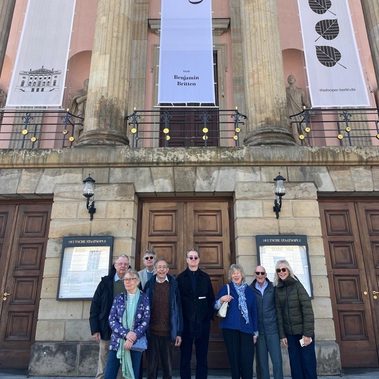
StoriesAt the end of April, nine lovely members of Britten Pears Arts along with myself spent six exciting days in Berlin as part of the recently resurrected ‘Friends Flyaways’ with Kirker Holidays.
Hailing from the depths of Suffolk, the boroughs of London and the quiet realms of Shropshire, we ten strangers bustled through the buzz of Heathrow airport onto a swift flight to Germany’s capital city.
Fingerprints and faces scanned, and polite "danke schön”s offered to passport control, we boarded the first of many ‘VIP buses’ as we headed right through the heart of Berlin to the Westin Grand Hotel with our tour leader, the ever-knowledgeable Barry Cheeseman of Kirker Holidays.
The first evening set the tone for what was quickly to become a trip filled with unforgettable experiences in the world of music and the arts. Gathered round several bottles of a local white wine, we were treated to a meeting with the vivacious mezzo-soprano Rosie Aldridge, who was set to play Mrs Grose for the final time in the Staatsoper’s production of the ‘Turn of the Screw’. With heads full of witty anecdotes and much to look forward to, one takeaway for all was don’t ask an opera singer what a dramaturg does….
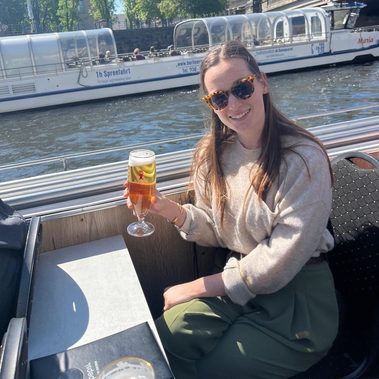
A small novel could be written on this special trip, which fluctuated between moments of great humour, times of deep reflection, and many musical escapades. From beers shared on boats, heads tilted at the ‘pregnant oyster’ (one of many of the city’s more alternative architectural moments), to miles and miles walked through the never-ending galleries and museums across the city, this was a trip filled with laughter, learning, and importantly, new friendships.
So here are my top three musical highlights we were treated to, and for those who have never visited, three music-themed reasons to do so!
- Turn of the Screw at the Staatsoper
Rosie’s hesitation to give any teasers for this production, aside from the ‘spinning set’ soon made sense as, whether to your taste or not, this production never failed to surprise and keep you on the edge of the (very comfortable) seats.
An enormous set of indistinguishable rooms saturated in that deep country house red, with windows and doors seemingly leading to nowhere and everywhere all at once, rested on an even larger rotating floor, as with each ‘turn of the screw’ the set moved, leaving audience and cast alike disorientated, as if you too were falling victim to the madness descending on the house. (Although this disorientation went a little beyond the performance as we tried to leave the Staatsoper - filled with ever spiralling staircases I found I’d led the poor souls who decided to follow me down to the depths of the cloak room multiple times in search of the exit!).
The decision to have Miles and Flora played by adults quickly became apparent, as the production played with multiple threads. From a kiss shared between Mrs Grose and the Governess (now this Rosie definitely kept quiet!), to enormous puppet heads donned when the children were possessed, it really was a unique, alternative and exciting take on one of Britten’s most popular operas.
This being my first time seeing a production of Turn of the Screw, I don’t quite feel qualified to provide a truly insightful analysis of the performance, however it is undeniable the talent on show was immense and audiences were enraptured by it. Young and old, black tie and jeans and a tee, it felt all had gathered to soak in the undeniably special atmosphere of the Staatsoper building and the exciting musical experiences happening within.
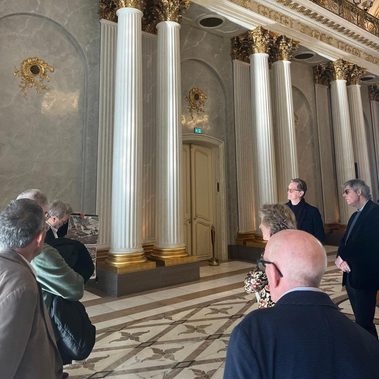
We were lucky enough to be given a private tour of the Staatsoper before the rush of audiences arrived. A building gilded in gold and pastel-coloured silks, its story of survival and reconstruction were incredible to uncover. The tour ended in one of the most private rooms of the opera house - the former meeting room of the directors. Once one of the most ‘bugged’ rooms in war-time Berlin, we had a far lighter experience meeting the Staatsoper’s dramaturg Olaf A. Schmitt (and yes we did find out what a dramaturg does!).
2. Herbert Blomstedt conducting the Berliner Philharmoniker for Bruckner’s Symphony No. 7
Before we entered into this special performance, we met with Andrea Zitzschmann, General Manager of the Berliner Phil, in their Green Room, to get a behind-the-scenes take on what it’s like to run the operations of not only this world-famous orchestra, but also the venue itself!
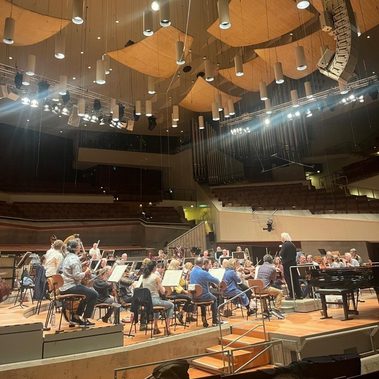
Designed by Hans Scharoun in the mid-1950s, this spatial vision of a concert hall places music at its architectural centre. Mimicking three pentagons placed at angles on top of each other, there are no distinct floors, as audiences surround the stage from all sides and teeter on top of each other, meaning everyone receives fantastic views and astounding acoustics.
With Herbert Blomstedt about to enter his 99th year, Andrea told us of her relief when she spoke to him that afternoon in the dressing room and saw him not only fit and well but still finding new takeaways from the score of Symphony No. 7!
This sensitivity to the piece expressed itself fully as Blomstedt commanded the orchestra and audience, seated at the podium, no baton in hand. With a pause to finish which felt eternal, a pin drop could be heard, before his hands lowered and the audience burst into rounds of applause and ‘bravos’.
3. An open rehearsal from the Chamber Orchestra of Europe, conducted by Sir Simon Rattle
Sir Simon is no stranger to Snape Maltings. As former music director of both the City of Birmingham Orchestra and of the London Symphony Orchestra (among many other roles!), we have been treated to many performances conducted in his energetic style.
With the Philharmonie to ourselves, we sat absorbed in Rattle’s delicate handling of the selected works: Brahms’ Fourth Symphony, Béla Bartók’s Music for Strings, Percussion and Celesta and Ferruccio Busoni’s Sarabande. Many commented on the orchestra’s rapport with Rattle, delving into the styles and techniques required for the expressive rhythms of Bartok in easy dialogue between each other.
This behind-the-scenes glimpse into the intricacies, thought processes and hidden meanings to each artistic decision was utterly absorbing. From claiming to hear the callouses of well-worked musicians’ fingers on notes requiring the soft pluck of an unblemished pad, to bringing forward some simple notes from oboes drowned in the singing tones of violins, no stone was left unturned.
We will soon be planning the next trip with Kirker Holidays. Let us know if you would be interested in coming along: [email protected]
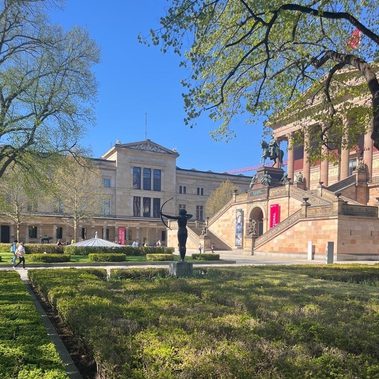
On top of all this musical wonder, we were treated to a museum pass, exploring some of the many incredible galleries and exhibitions Berlin has to offer. Be that romanticism at the Alte Nationalgalerie, the exploration of 20th century art, especially from artists of East Germany, in the Neue Nationalgalerie, or the endless Caravaggio’s, Bruegel’s, Boticelli’s, Titian’s (the list goes on!) of the Gemäldegalerie - we were left in awe of Berlin’s endless opportunities for cultural enrichment.
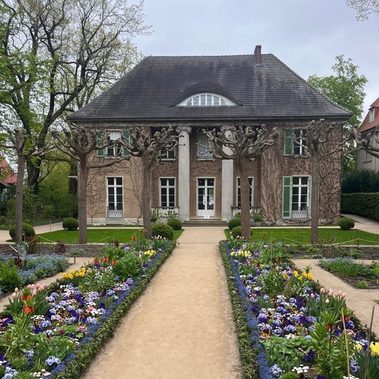
To close this trip on a quieter tone, we travelled out to the shores of Wannsee to explore the villa of impressionist artist Max Liebermann. An early proponent of the avant garde movement in Germany, our tour guide regaled us with various tales of the ways Liebermann upset his neighbours with his artistic choices. From geometric, linear garden layouts opposed to the more rotund styles of the day, and planting inspired by the psychogeography of space, light and colour, over the ‘showy’ planting of expensive, exotic plants, Liebermann’s villa in every essence stood for a stunning symbol of resilience and expression. This was a sobering and special moment to appreciate the lives of Max and his wife Martha, cut short by the contemporary oppressive regime, but beautifully preserved under the careful hands of the Max Liebermann Society.
With every day of this trip filled to the brim with memorable experiences, inspirational visual art and moving musical moments, I think it’s safe to say we look forward to the next trip with Kirker Holidays, wherever that might be!
Written by Cecily Harper from the Development Team.