In Conversation with: Jane Mackay
StoriesPainting Britten: 100 Visions of the Music
What happens when you listen to Britten with a paintbrush in hand?
In the year leading up to the 50th anniversary of his death, Jane Mackay found out, creating an ambitious sequence of 100 paintings, inspired by each of Britten's works.
Why Britten?
I grew up in a musical family and loved singing at the piano, and subsequently in choirs from primary school onwards. My first introduction to the music of Benjamin Britten was at my secondary school in Cambridge, where our music teacher organised performances of Saint Nicolas, Noye’s Fludde and A Ceremony of Carols. I was completely bowled over by this extraordinary music; the start of a lifelong passion.
Why Paintings?
I have painted as far back as I can remember. As a child, I believed that painting something that I could see in front of me was in some way ‘cheating’. So instead, I illustrated my internal thoughts and visions, especially those evoked by music
and poems. Many years later I discovered that the process of seeing colours and shapes in the music I listened to was a type of synaesthesia: an inherited neurological trait involving cross-sensory perception. I painted more and more music; mostly, but not exclusively, classical works, and often pieces that I had sung as a choral singer. I started to specialise in painting Britten’s music in the 1980s when I was confined to lying on the floor for five months with a slipped disc. I listened to many of Britten's works on tapes, and as soon as I could stand upright again, I started illustrating the music visions that had been coursing through my head while I’d been staring up at a white ceiling.
Why now?
To date, I have painted over 1,000 pictures of Britten’s music: some works in great depth (for example 63 paintings of Gloriana and 33 paintings of The Turn of the Screw), but there were many of Britten's compositions that I did not know at all, let alone had painted. Since 2026 is the 50th anniversary of Britten's death, I decided to paint every single one of his opus numbers in watercolour, and exhibit them in a group during the commemorative year.
Why 100?
There are 95 Britten opus numbers but some of them have an ‘a’ and a ‘b’: for example, Peter Grimes is op. 33, but op. 33a and 33b are the Four Sea Interludes, and the Passacaglia, respectively. The total adds up to slightly over 100 works, but because some numbers are used for more than one composition, 100 seemed a good figure to aim at and so that's what I did.
What was the paintings process?
I decided that the only way I could complete this project by the deadline was by becoming a virtual hermit for a year. So I told friends and family that I would not be seeing much of them for the time being, and drew up the drawbridge, working in my studio in London from the beginning of 2025. I painted mainly in watercolour, sometimes with two or three paintings on the go at the same time so that the first one could dry before the next layer was added. I researched the works that I did not know, reading biographies and letters, listening to many recordings, and studying scores. I tend not to do preliminary sketches because I find this takes away the energy from the final work, so I go straight into the painting with a clear vision in my head of what the finished image will look like.
How can a whole piece of music be summarised in one painting?
The paintings in this series usually started with a combination of synaesthetic colours and shapes. Many of the paintings were a mixture of abstraction and figuration, including historical and musical references, together with memories of live performances. There were also images alluding to Britten’s life, and the geographical, political and personal aspects of his situation at the time of a work’s composition. The book which accompanies the exhibition, Painting Britten:100 Visions of the Music, aims to provide the background for each piece and an explanation of the processes involved in the creation of each image.
The Painting Britten exhibition takes place in the Pond Gallery from 14–25 June 10.30–5.30pm (closed on 18 June).
Thursday 18 June: a selection of paintings will be displayed in the marquee at The Red House 10.30–4.30pm. Free entry includes refreshments, served at 12 noon and 2pm.
Paintings and books for sale; book signing; music by Nick Daniel (oboe). Free entry to marquee. No booking needed and all are welcome.
Jane Mackay can be contacted on email: [email protected] and via her website www.soundingart.com
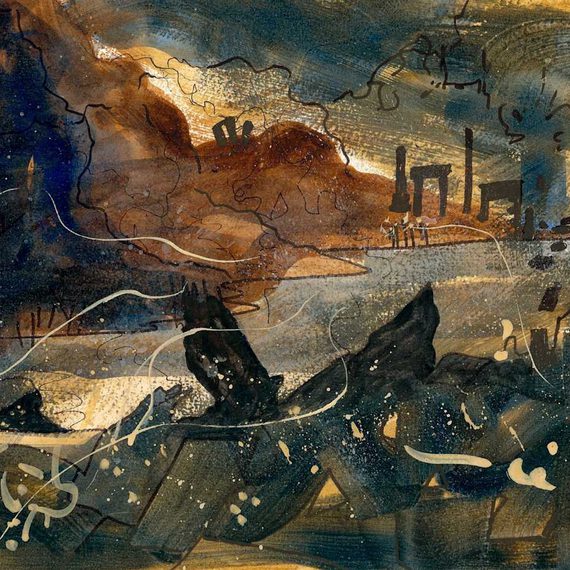
Symphony for Cello and Orchestra, op. 68
©2026 Jane Mackay All Rights Reserved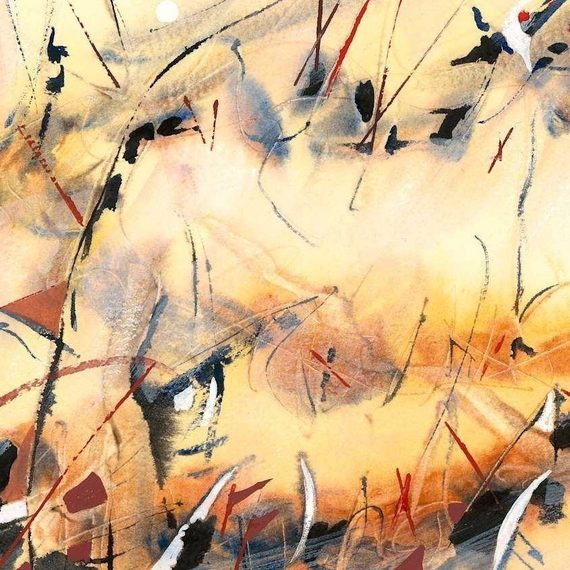
String Quartet No.1 in D, op. 25
©2026 Jane Mackay All Rights Reserved