What first inspired you to draw a connection between 18th century fencing etiquette and the Baroque double-concerto tradition?
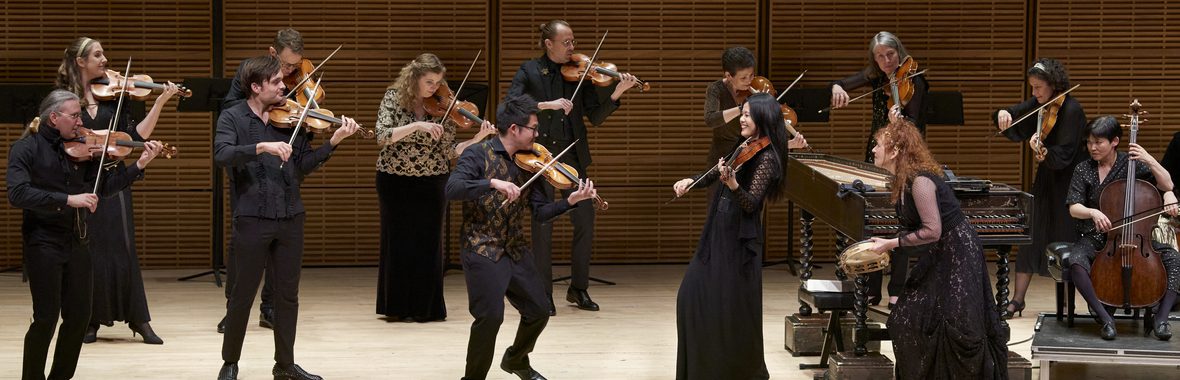
I’ve always been fascinated by the different “Affekts” or moods that baroque music evokes. But last year I started noticing that certain movements of double-concertos have a “mood” that seems similar to fencing – the daring “jabs” and sense of rivalry between the 2 soloists. So I started reading about fencing etiquette in the 18th century. I soon learned that fencing, as it was taught in those days, was actually about several different moods – just as baroque music has a different Affekt for each movement.
Thrusting techniques, as taught in the fencing schools of France, emphasized grace and elegance. The etiquette of the fencing schools fostered a culture of courtesy and friendship. Before engaging in a drill with another student, the students performed a reverence/salute to each other – just as musicians might do at the beginning of an improvisatory duet. This obligatory salute was intended to show respect to the adversary. Then the “assault” would be begin, usually with formality and a sense of dialogue. Later on, perhaps a restful promenade. And then, a more fiery assault.
Bach’s Concerto in D minor for two violins is so well known and recognisable – how do you guide the soloists in shaping the expressive character of the piece to bring something new to it?
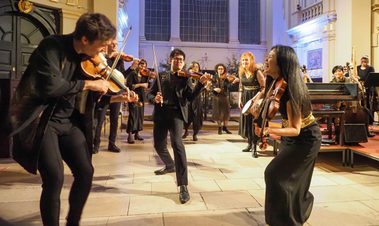
I probably drive musicians crazy, because I do have very specific interpretive ideas and I try to meld each phrase of the piece in that way. I typically work with the soloists and continuo first, before bringing the piece to the full band. The goal of the soloists’ “pre-rehearsal” is to turn the soloists into my allies so we can bring this interpretation together to the band. I think the Bach Double is so beloved because it does have such clear and evocative Affekts – the first movement is a dramatic conversation between the soloists. The second movement is heavenly poetry. And one can easily imagine a soloist shouting “en garde!” before launching into the wild and fiery third movement.
Do you see parallels between today’s performance culture and the competitive spirit of 18th century musicians?
There was often quite a bit of rivalry between musicians of the 18th century – there are plenty of stories to read in the history textbooks. But there were also some lovely friendships such as the one between J.S. Bach and Telemann. Today, at least in my experience, I think that most musicians are mutually supportive and truly happy for each others’ successes. Perhaps we’ve realized that we are so fortunate and blessed to be able to do what we love, in a troubled world where so many people are displaced, suffering, or in danger. Being a musician is a blessing, and we don’t take it for granted.
What are the specific challenges of playing on original instruments, particularly touring with them?
Many! Because of the gut strings, period instruments always need to “breathe” the air of the hall for a couple of hours in order to acclimatize and become stable for tuning. And then, there is the fact that they are not standardized at all. So borrowing or hiring instruments is a bit stressful because each instrument is so different. When we tour in the U.S., the musicians usually fly but our 2 production guys (the beloved team of Tom and Martins) drive a cargo van containing our harpsichord, contrabass, cellos, and theorbo. But when we come across the pond, of course that’s not possible. So we must hire these instruments in London. We have done it several times, but it’s always a bit stressful. One harpsichord might have wider keys than another, or a much stiffer action…. And the theorbo might have a different tuning. It keeps us on our toes!
Outreach work is becoming more and more important in today’s political climate. How does Apollo’s Fire connect with young people and create future audiences?
Reaching out to young people – and also to adults who might be new to classical music – is an important part of our mission. In Cleveland where we are based, we play about 30 outreach events per year. These include free Family Concerts on weekends (interactive programs for age 6-96), free workshop-concerts in public schools, Bistro concerts in popular restaurants, and a week of 6 “Countryside Concerts” which are historical folk music, performed in rustic barns and amphitheatres.
In addition, I think our YouTube videos might be our most effective way of reaching new and younger audiences. We have over 20 million views (total). And the comments that viewers post to our videos are in many languages, from around the world! Last month, a Serbian ensemble asked me to send them the materials for my “La Folia” arrangement. I did, and afterwards they sent me a delightful video of their rehearsal and the performance. So I feel that we have these new musician friends in Serbia.
The acoustic at Snape Maltings is particularly sympathetic to these instruments but are there other venues that you think work well for the group and your repertoire?
We also love the acoustics at St Martin in the Fields, where we are playing three programmes over the 24th and 25th April. Another favourite is Ozawa Hall at the Tanglewood festival, in the Berkshire Mountains of Massachusetts. We also love to play in old barns in the countryside – the older the better!