Benjamin Britten travelled abroad extensively throughout his life. Lucy Walker’s two-part article, Britten Abroad, explores the length and breadth of his travels, and the impact they had on his life and his music.
Here in Part One, Lucy provides some background to Britten’s journeying and explains what it was like more generally to be “A Briton Abroad” during his lifetime.
Well, here we are!Benjamin Britten writing to his parents from Florence, 30 March 1934
If we were to think of the top three most defining aspects of Britten’s biography, we might choose: his relationship with Peter Pears; his many operas; and that he lived for most of his life in Suffolk. Of those, the latter is the most enduring in that he was born in Lowestoft, in the north east of the county, and lived for most of his adult life in either Snape or Aldeburgh (with a further composing retreat in Horham, a little further inland: see the Google map below). Suffolk was not only his home, but represented the community for whom he composed. As he put it in his speech on accepting the Aspen Award in 1964, “I write music, now, in Aldeburgh, for people living there…my music now has its roots, in where I live and work”. His rootedness in Suffolk was something he returned to time and again. On being made Freeman of Lowestoft in 1951, he waxed long and lyrical about the county of his birth, adding “when I visit countries as glorious as Italy, as friendly as Denmark or Holland – I am always homesick, and glad to get back to Suffolk”. Suffolk was the only place, apart from a couple of exceptions, where he could compose, and from the late 1950s onwards it was where his major works received their first performances.
From all this, we might reasonably assume that Britten barely left East Anglia, other than a few forays across the channel. But this is far from the case. While Suffolk was the domestic and artistic centre of his life, from the 1940s onwards there was another side to Britten which craved travel and new sights – and new sounds. In his music, as well as in his life, Britten fluctuated between being progressive and entrenched, moving between an absolute rootedness in Suffolk, and a wanderlust that took him to the Far East, Russia, South America, and Australia, amongst many other parts of the world. He seemed to require his Suffolk stability in order to partake in adventures, and take more risks.
His ability to do so was partly due to his position as a middle-class, increasingly affluent professional composer, and partly because as a highly respected composer-performer he would be invited to give recitals in far-flung locations, all expenses paid (often by the British Council). Indeed, he rarely took a straightforward holiday. Apart from a very few occasions, Britten travelled for work. There were maybe a few days off, but his trips largely comprised a hectic programme of recitals and meet-and-greets in local embassies. Peter Pears was his regular travelling and recital companion the story of Britten Abroad is, for the most part, a story of both men.
It is fair to say that Britten’s globe-trotting was very unusual compared to most British people, especially in the 1930s–1950s. The first known package holiday in the UK took place in 1950, but it was on a very small scale, and very much marketed to middle-class travellers. The 1948 Pay Act allotted a two-week holiday to working Britons, the large percentage of whom travelled to coastal regions of the UK for their annual holiday. A 1946 survey, commissioned by the Mass Observation project, found that there was a marked post-war ambivalence to travelling abroad; that holidaying in Britain was viewed as the more patriotic option. Other views were expressed by those who had travelled with the armed forces during the recent war – and never wanted to leave home again. The report also noted that resistance to foreign travel included “language difficulties; fear of homesickness; … the effort and trouble involved; [and] mistrust of foreigners”. (“Effort and trouble” involved was partly mitigated by the further spread of package holidays, which dealt with at least one potential stumbling block; but this was some years away.)
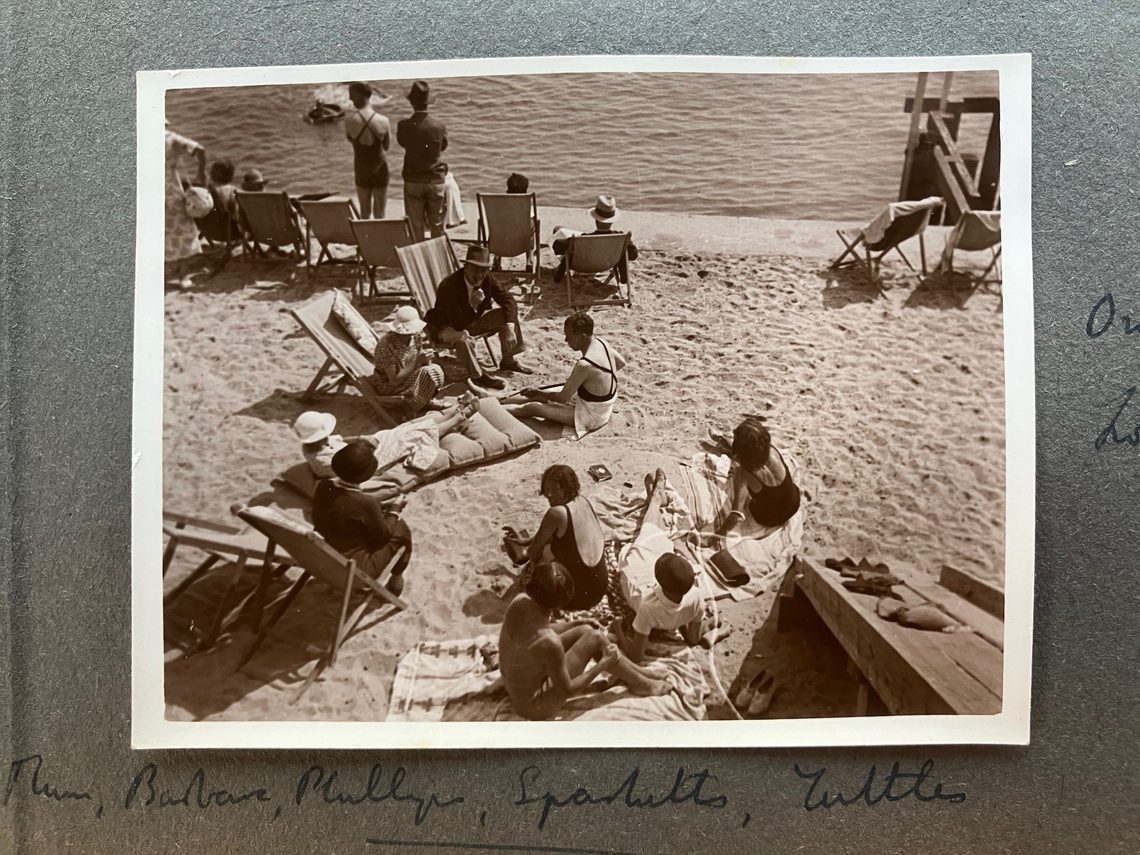
Photograph from Britten’s seaside scrapbook of 1936
What would have been termed the intellectual or cultural class, however, frequently did travel. And composers and musicians perhaps even more than most, either as international bookings for opera houses or concert halls, or promoting and performing their own music. Music allowed – even required – travel more than any other artistic medium. As a composer and a performer of great renown, Britten had a busy schedule of international commitments, starting in the late 1940s and not really slowing down until the early 1970s. Before he became an in-demand soloist and conductor, though, Britten’s travel habits were only slightly different to that of other Britons.
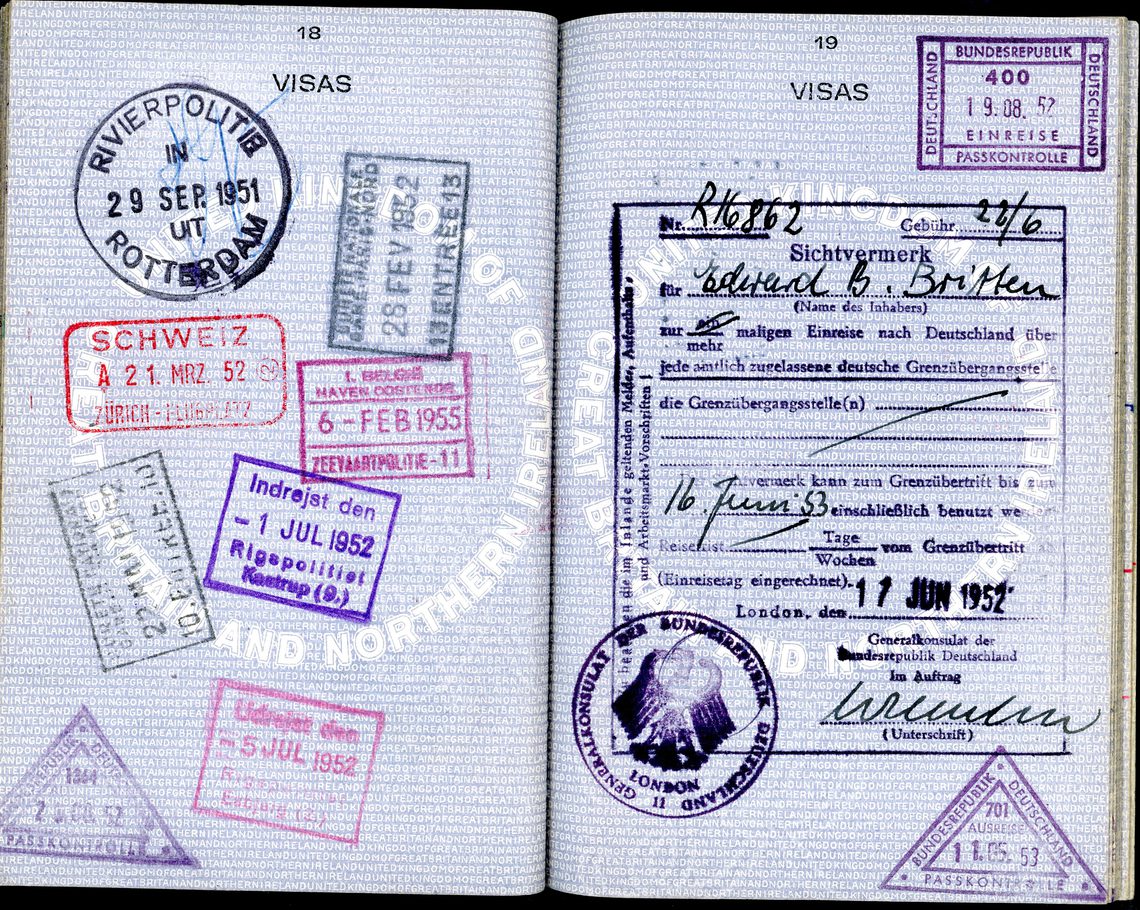
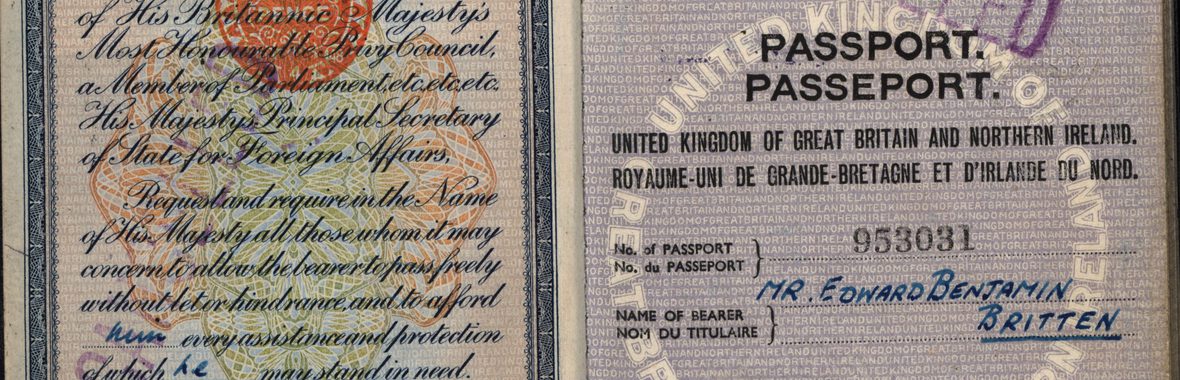
Britten’s passport
Britten did not go abroad until he was 20 years old. One of his early works, Phantasy, op. 2 (for oboe and string quartet) was selected for performance in the International Society for Contemporary Music (ISCM) conference in Florence. With his friend John Pounder, Britten set off to Paris on 28 March 1934 taking a whistle-stop tour across the city during the day, before journeying onwards to Italy. He wrote a colourful account of the trip to his parents, describing the heat, the “transparent” blue of the sea, and that with all the palm trees around it was “quite tropical”. He adds, in classic Englishman abroad style, “We got to Pisa – saw the good old tower – and changed there – with some difficulties, none of us knowing a word of the language…”
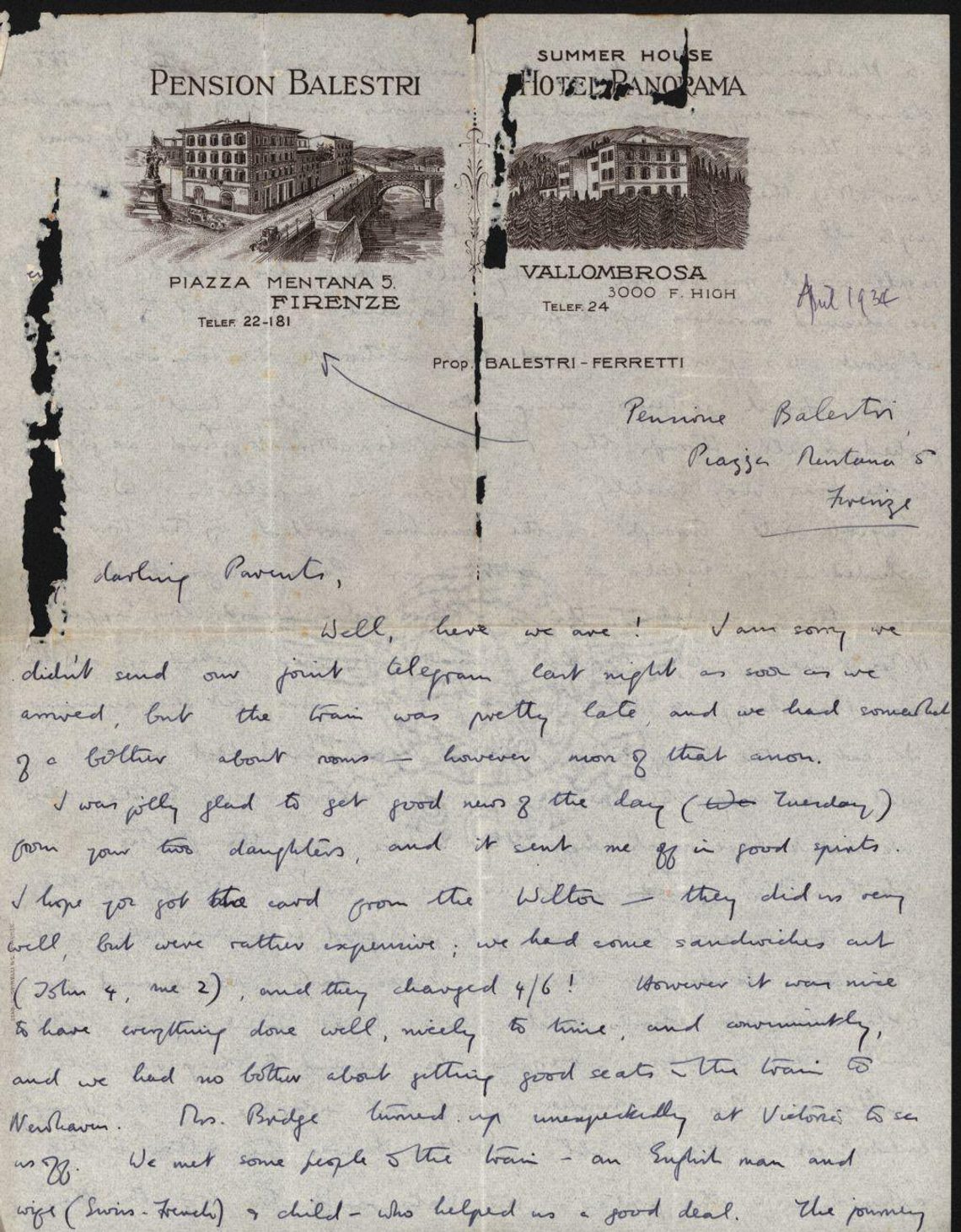
Extract of letter from Britten to his parents
The trip was cut short due to the death of Britten’s father on 6 April (the day after the Phantasy performance). Later in the year, as a relatively seasoned man of the world, Britten was awarded a six-week travel scholarship, and took his bereaved mother with him to Switzerland, Austria and Germany. They took in a remarkable number of concerts and opera performances, and socialised with international publishers and conductors. The trip included what must have been Britten’s first flight, from Paris to London on the return journey (“it was thrilling in the extreme, & so easy & convenient”). Interestingly, as Britten’s biographer Paul Kildea points out, these trips did not especially inspire him musically, although he did compose a Viennese-style movement of his Violin Suite that year. Later on, travel would prove to have a galvanising effect on his music, even to the point of releasing a composer’s block.
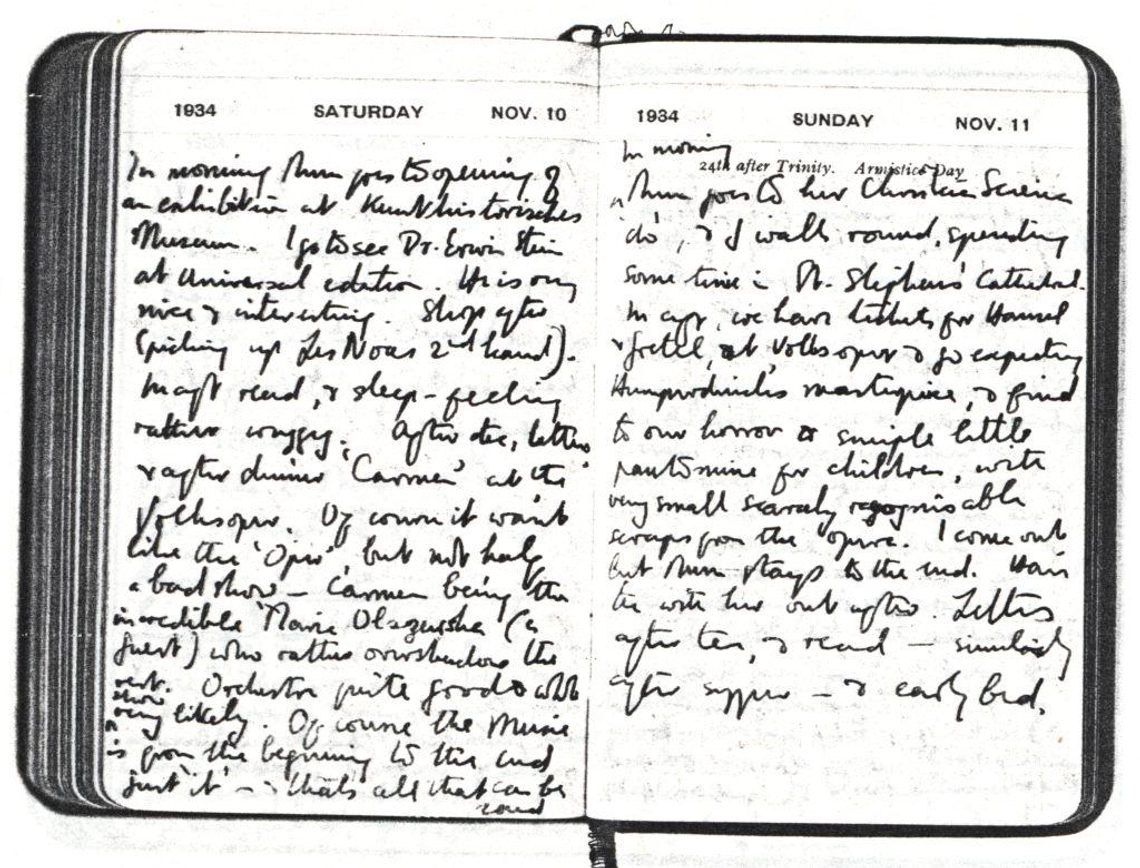
Extract from Britten’s diary, 10 November 1934
Musical Travelling
It could be said that, musically, Britten was well-travelled from an early age. As a precocious teenager he had composed Quatre chansons françaises (1928) settings for voice and orchestra of poems by Victor Hugo and Paul Verlaine, as well as a few other French songs (possibly inspired by a French girl, Raymonde Chevillard, who was staying with the Britten household in the summer of 1928; she is the dedicatee of another song, Dans les bois, composed the same summer).
The British composer Frank Bridge, who was Britten’s musical mentor for an influential period of his teens and twenties, was European at heart, largely influenced by continental composers, and not really expressing any kind of British nationalism in his own works. Bridge had encouraged Britten to study with the Austrian composer Alban Berg in the early 1930s, but Britten was forbidden to do so by his parents, due to some vague reasons of “unsuitability” (whether that was on musical or moral grounds is unclear). To be musical in the 1930s in any case was to be open to European sounds, as there was, simply, more European music available to listen to than British. Later in life, Britten would set further French poetry, in his song cycle Les Illuminations, as well Italian, German and Russian verse.
Britten’s next trip abroad was in 1936, to the ISCM conference in Barcelona, where his Suite for violin, op. 6 was performed. He visited Mont Juic, which inspired a further work the following year, his joint orchestral work Mont Juic, op. 12 with composer Lennox Berkeley. In 1937 following year he was taken to Paris for a trip by Frank Bridge and his wife.
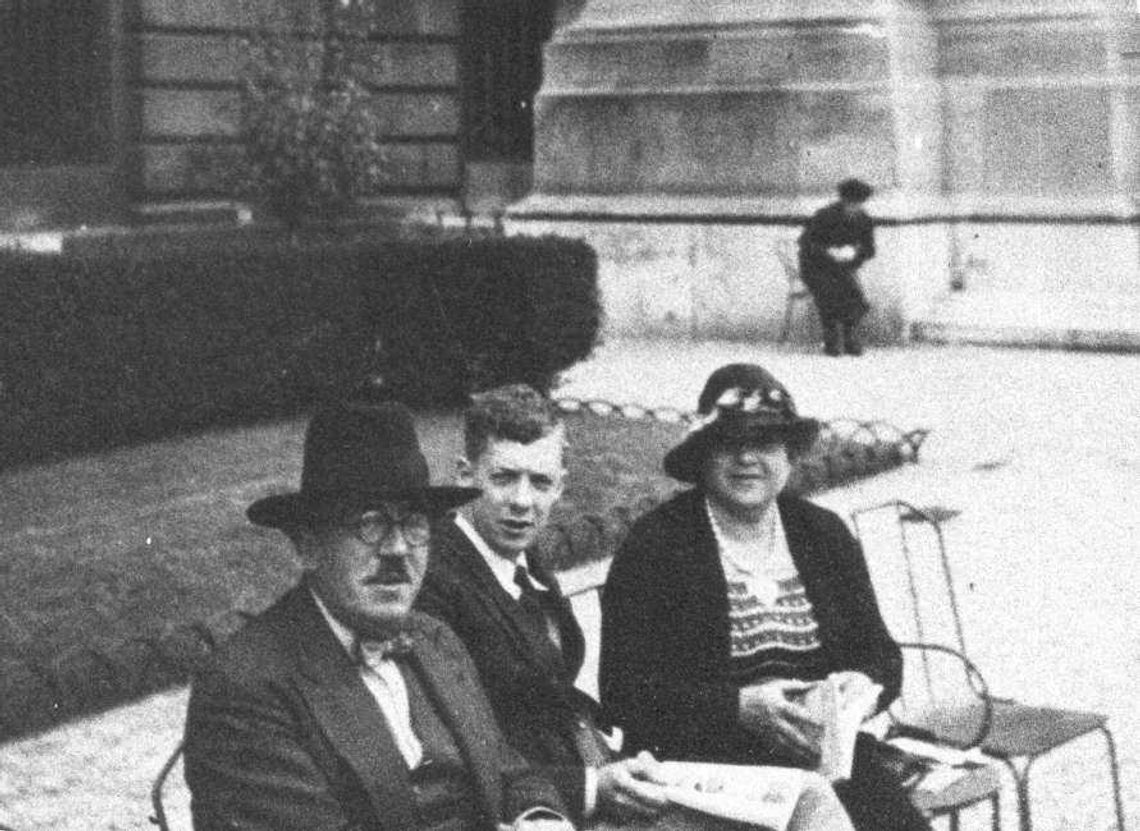
Benjamin Britten with Frank and Mrs Bridge in Paris
This was a holiday, but – as noted above – Britten rarely just went on holiday. There was a skiing trip in 1955, but even then Britten found the time to throw together the Alpine Suite for recorders to entertain his friend Mary Potter, who had injured herself. A visit to St Kitts and Nevis in 1967 was a relatively rare example of a non-working vacation. Its documentation is also worth mentioning: some 40 years after the trip, the Archivist at The Red House at the time (Jude Brimmer) discovered a camera which had a roll of undeveloped film inside. These pictures were carefully developed, and turned out to be photographs from that Caribbean trip.
Image gallery
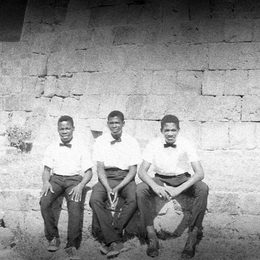
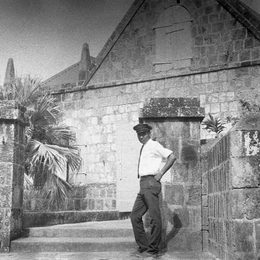
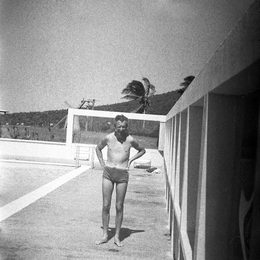
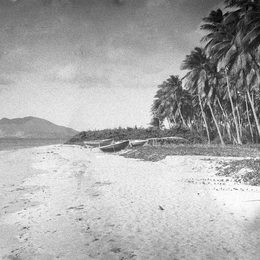
The slow-moving relaxed days seemed to go on for ever, with the cup of tea at 7am, the dip in the bright blue pool before breakfast, the eager attentions of Wendell and his colleagues, the trundle down to the beach, the lazy hours on the sand under the coconut palms . . .the rum and ginger at sun-down-and-into-the-sea, the sudden showers & gusts.Peter Pears, Travel Diaries
But more often, holidays had work commitments folded into them. A typical example is a visit to Greece in 1962. Britten, Pears and Mary Potter stayed in Nafplion, and visited the wealth of historical sites in the Peloponnese region. In the second half of the trip, after effectively exchanging Mary Potter for his assistant Imogen Holst at Athens airport, Britten worked on the orchestral score of his War Requiem in the mornings, allowing himself further excursions in the afternoon. They also attended receptions organised by the British Council, which were a feature of many of Britten’s international trips, and something he rarely enjoyed; he wrote to his sister Barbara from Argentina in 1967, “We have, of course, loads of press conferences (horrid!) & Ambassadorial & other receptions (which I hate almost more, because one has to be introduced to hundreds of people & try to be interested!)”.

Press conference in Tokyo
Coming soon – Britten Abroad: Part two
Lucy Walker continues her article with a closer look at the countries Britten visited as a professional composer.
Sources Consulted and Further Reading
Tourists: How the British Went Abroad to Find Themselves, by Lucy Lethbridge (2022)
Austerity Britain: 1945-1951, by David Kynaston (2007)
Never Had it So Good: A History of Britain from Suez to the Beatles, by Dominic Sandbrook (2005)
Lives of Houses, edited by Hermione Lee and Kate Kennedy (2020)
Benjamin Britten: A Life in the Twentieth Century, by Paul Kildea (2013)
Benjamin Britten and Russia, by Cameron Pyke (2016)
Letters from a Life: Selected Correspondence of Benjamin Britten, vols 1-6 , edited by Mervyn Cooke, Philip Reed and Donald Mitchell (1991-2012)
Journeying Boy: The Diaries of the Young Benjamin Britten, edited by John Evans (2009)
Britten in Pictures, edited by Lucy Walker (2012)
Read next
Benjamin Britten, Curlew River and Sumidagawa
“I shall never forget the impact made on me by the Japanese theatre”. This was Benjamin Britten, broadcasting to Japan in 1958, two years after his…
Britten Now and Then
Fifty years after his death, Dr Lucy Walker considers the remarkable staying power of Britten’s music – and of his fascinating life story.
Archive Treasures: Britten and Australia – a ballet that might have been
Scanning someone’s shelves is a quick way to find out their interests: their books and music provide a map of their mental world, and pulling something…